


 Site Survey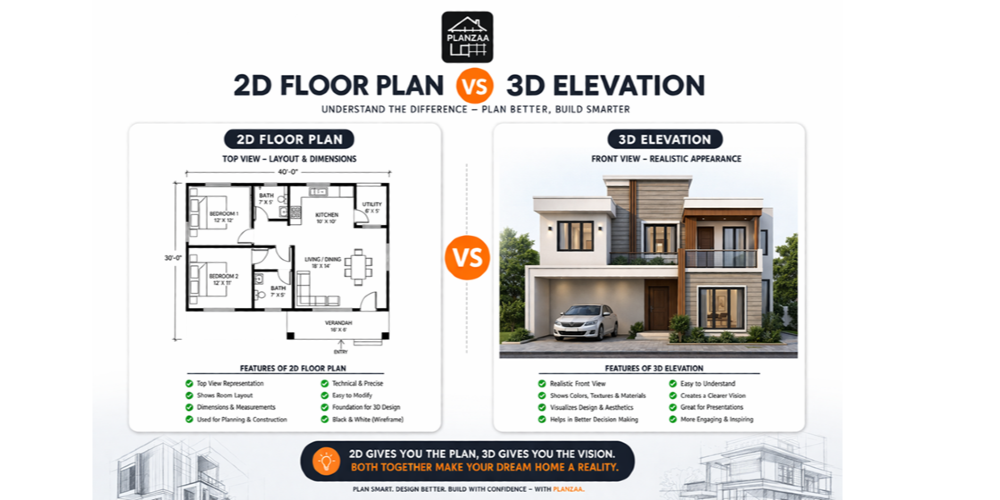
2D Floor Plan vs 3D House Design — What Is the Difference?
When homeowners start planning their house, one of the most common questions they ask their architect is: "Do I need a 2D plan or a 3D design — and what is the difference between the two?"
The short answer is: you need both. But they serve very different purposes, and understanding what each one does will help you make better decisions when working with your architect or using a platform like Planzaa.
In this article we will explain exactly what a 2D floor plan is, what a 3D house design is, how they are different, when you need each one, and why skipping either of them is a mistake.
WHAT IS A 2D FLOOR PLAN?
A 2D floor plan — also called a naksha, house map, or layout drawing — is a top-down view of your house drawn to scale on paper or digitally. It shows the layout of your home as if you are looking at it from directly abov
A 2D floor plan shows:
- The shape and size of every room
- Exact dimensions of each room in feet or metres
- Placement of doors and which direction they open
- Placement of windows on each wall
- Position of staircases, bathrooms, and kitchen
- Walls, columns, and structural elements
- Balconies, passages, and utility areas
What a 2D floor plan does NOT show:
- How the house looks from outside
- The height of rooms, windows, or walls
- What materials or colours will be used
- Any sense of depth or three-dimensional space
A 2D floor plan is the technical foundation of your entire house. Every other drawing — structural, electrical, plumbing, 3D — is built on top of the 2D floor plan. Without it, nothing else can be designed or approved.
The 2D floor plan is also the document you submit to the municipal authority for building plan approval. It must be drawn by a COA-registered architect and stamped with their seal for the application to be accepted.
WHAT IS A 3D HOUSE DESIGN?
A 3D house design — also called a 3D elevation, 3D rendering, or 3D visualisation — is a realistic, three-dimensional image of how your house will look after it is built. It gives you a visual preview of your home before a single brick is laid.
A 3D design shows:
- The exterior appearance of the house from different angles
- The facade — front face of the building with windows, doors, balconies
- Materials and textures — tiles, stone cladding, paint colours, glass
- Roof style and shape
- Garden, driveway, or boundary wall if included
- Interior 3D views showing how rooms will feel from inside
What a 3D design does NOT show:
- Exact technical dimensions
- Structural details
- Electrical or plumbing information
- Legal or municipal drawing information
A 3D design is a communication tool. It helps you, your family, and your construction team understand what the final house will look like — before any money is spent on construction. It removes guesswork and prevents costly changes later.
THE KEY DIFFERENCES — SIDE BY SIDE
2D Floor Plan:
- View: Top-down (bird's eye view)
- Purpose: Technical layout and room planning
- Shows: Dimensions, room sizes, door/window placement
- Used for: Municipal approval, construction guidance
- Required legally: Yes — must be COA certified
- Created by: Registered architect using AutoCAD or similar
3D House Design:
- View: Realistic exterior and interior perspective
- Purpose: Visual preview of the finished house
- Shows: Appearance, materials, colours, depth
- Used for: Client approval, family decision making
- Required legally: No — but highly recommended
- Created by: Architect or designer using SketchUp, Revit, Lumion
WHICH ONE DO YOU NEED FIRST?
Always the 2D floor plan first.
The 2D layout must be finalised before the 3D design can be created. Your architect cannot render a 3D view of a house whose room layout, dimensions, and facade have not been decided yet.
The correct order is:
1. Site survey — measure the plot accurately
2. 2D floor plan — design the layout of all rooms and spaces
3. Review and finalise the 2D plan with your family
4. 3D elevation — create a realistic visual of how the house looks
5. Review the 3D design and confirm materials and style
6. Structural, electrical, and plumbing drawings — technical service designs
7. Submit for municipal approval
Skipping the 2D floor plan and jumping straight to 3D is a mistake many homeowners make. They see a beautiful 3D rendering and fall in love with it — only to discover later that the room sizes are impractical, the kitchen has no natural light, or the staircase position wastes too much floor space.
The 2D plan protects you from these problems. It is where the practical decisions are made.
DO YOU NEED BOTH 2D AND 3D?
Yes — and here is why.
The 2D floor plan tells you your house will function correctly. The 3D design tells you your house will look the way you imagined. Both are necessary for a complete, satisfying result.
Real situations where 3D design saves money and prevents regret:
Situation 1: A family in Noida approved their 2D floor plan and started construction. Only when the walls were up did they realise the main bedroom window faced directly into their neighbour's bathroom. A 3D view would have shown this immediately.
Situation 2: A homeowner in Ghaziabad chose a flat roof design based only on the 2D drawing. When he saw the 3D elevation, he realised the flat roof made his house look unfinished compared to neighbours. He asked for a parapet and cornice design — which was added before construction at zero extra cost.
Situation 3: A family in Delhi changed the exterior tile colour three times during construction because they had no 3D reference. Each change cost labour and material money. A 3D rendering upfront would have settled this before construction began.
WHAT ABOUT 3D INTERIOR DESIGN?
Apart from exterior 3D elevation, architects and interior designers also create 3D interior views — showing how individual rooms will look from inside.
3D interior design shows:
- Furniture arrangement and scale
- Wall colours and textures
- Flooring material and pattern
- Ceiling design — false ceiling, lighting
- Kitchen layout — cabinet placement, countertops
- Bathroom tiles, fittings, and fixture positions
3D interior views are especially useful for living rooms, kitchens, and master bedrooms — where design decisions have the most impact on daily life and the most potential for expensive mistakes.
HOW MUCH DO 2D AND 3D DESIGNS COST IN INDIA?
Costs vary based on plot size, city, and the architect or platform you use. Here are approximate ranges for Delhi NCR:
2D Floor Plan only:
- Small plot (up to 1000 sq ft): ?5,000 – ?15,000
- Medium plot (1000–2000 sq ft): ?12,000 – ?25,000
- Large plot (above 2000 sq ft): ?20,000 – ?50,000
3D Exterior Elevation only:
- Standard residential: ?8,000 – ?20,000
- Premium with multiple angles: ?15,000 – ?35,000
2D + 3D Combined Package:
- Small to medium residential: ?18,000 – ?45,000
- Full package with structural and services: ?35,000 – ?80,000
Planzaa offers both 2D floor plans and 3D elevation designs as individual services or as part of the Full Home Package — giving you professional quality at transparent, fixed pricing with no hidden charges.
COMMON MISTAKES HOMEOWNERS MAKE
Mistake 1: Approving a 2D plan without visualising it in 3D
Many people cannot mentally convert a flat drawing into a three-dimensional space. They approve the 2D plan thinking everything looks fine — and are surprised when the constructed house feels different from what they imagined. A 3D view bridges this gap completely.
Mistake 2: Choosing a 3D design from the internet and asking the architect to copy it
Many homeowners download images of houses they like from Pinterest or Instagram and ask their architect to copy the design. This almost never works — because every plot is different in size, orientation, road access, and surroundings. Always start with your specific plot measurements and build the design from scratch.
Mistake 3: Skipping 3D to save money
Skipping the 3D design feels like a saving but often leads to expensive changes during construction. A 3D design typically costs ?10,000 – ?20,000. Construction changes made to fix a design you did not like can cost ?50,000 – ?5,00,000 depending on the stage of construction.
Mistake 4: Not involving all family members in the review
The person who approves the 2D and 3D design is often the head of the family. Other members — especially the person who will use the kitchen most — often have feedback that would change the layout significantly. Always review both 2D and 3D with the entire family before giving final approval.
HOW PLANZAA HANDLES 2D AND 3D DESIGN
At Planzaa, every project begins with a site survey — so your architect has accurate plot data before designing anything.
Our architect then creates:
- A detailed 2D floor plan showing every room, dimension, and service point
- A realistic 3D exterior elevation from the front and side
- 3D interior views for key rooms on request
You review everything through the Planzaa customer app. You can request revisions, ask questions, and give final approval — all digitally, without visiting any office.
Once approved, Planzaa delivers construction-ready drawings including structural, electrical, and plumbing layouts — everything your contractor needs to begin building.
FINAL THOUGHTS
A 2D floor plan and a 3D house design are not competing options — they are two stages of the same design process. The 2D plan ensures your house works. The 3D design ensures your house looks the way you imagined.
Together they give you confidence, clarity, and control before a single rupee is spent on construction.
Ready to see your dream home in 2D and 3D before construction begins?
Visit www.planzaa.in or call +91-9818176157 for a free consultation.
FREQUENTLY ASKED QUESTIONS
Q1: Is a 3D design the same as an architectural drawing?
No. An architectural drawing is a technical 2D document used for construction and legal approval. A 3D design is a visual representation created to help you understand how the house will look. Both are produced by architects but serve different purposes.
Q2: Can I get a 3D design of my house without a floor plan?
No. A 3D design is always based on the 2D floor plan. Without a finalised floor plan, there is no accurate basis for creating a 3D view. Any 3D image created without a proper floor plan is just a generic template — not your actual house.
Q3: How many 3D views should I get for my house?
For a standard residential house, you should get at least two exterior views — front elevation and one side elevation. For a corner plot, three views are recommended. Interior 3D views can be added for living room, kitchen, and master bedroom if needed.
Q4: How long does it take to get a 2D and 3D design?
With proper site data and clear requirements, a 2D floor plan takes approximately 5 to 7 working days. A 3D elevation takes another 4 to 6 working days after the 2D plan is approved. Total time from start to final 3D: approximately 2 to 3 weeks.
Q5: What software do architects use for 2D and 3D design?
For 2D floor plans, architects typically use AutoCAD or ArchiCAD. For 3D design and rendering, common tools include SketchUp, Revit, Lumion, and 3ds Max. Planzaa's architect network uses industry-standard tools to deliver professional-quality drawings and renderings.